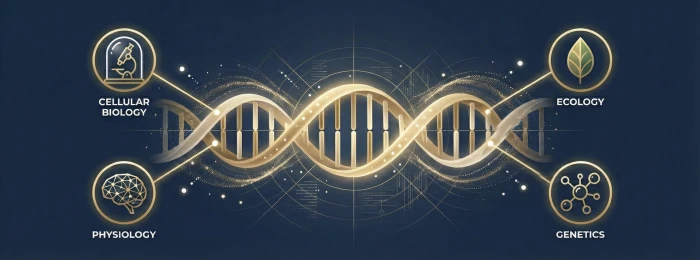
Master AP Biology &
Secure Your College Future
Dive deep into the mechanics of life with a curriculum designed for high achievers. From molecular genetics to ecology, our expert-led course demystifies complex biological systems, preparing you not just for a 5 on the exam, but for a future in STEM.
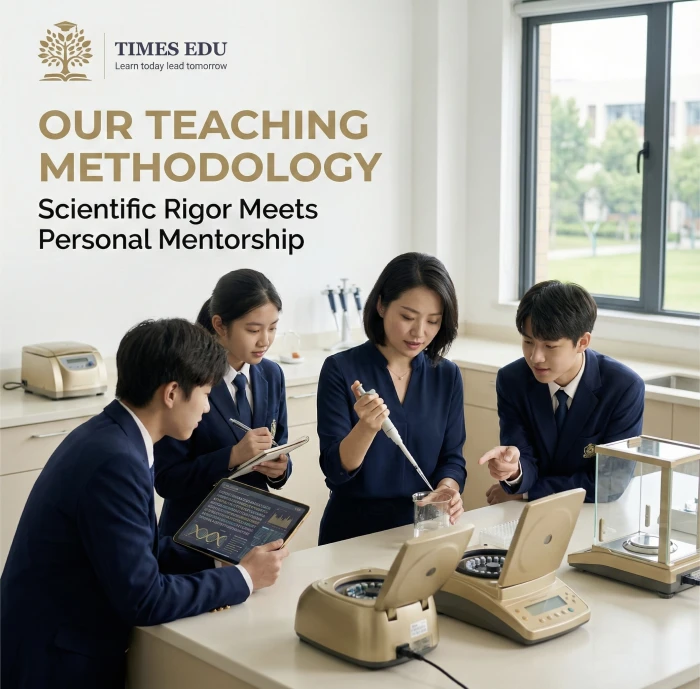
See How We Teach Biology
Get a glimpse of our interactive classroom environment where complex diagrams come to life.

Course Outcomes
Beyond the exam score, you will develop critical scientific skills.
Exam Mastery
Achieve a score of 4 or 5, earning college credits at most universities.
Lab Proficiency
Design experiments and analyze data sets confidently using standard deviations and error bars.
Scientific Writing
Construct cohesive arguments in Free Response Questions (FRQs) using Claim-Evidence-Reasoning.
Critical Thinking
Connect concepts across units, linking molecular changes to ecosystem-level impacts.
Our Teaching Methodology
We don't just lecture; we engage. Our pedagogy is built on the "Explore-Explain-Apply" framework, ensuring deep retention of biological principles.
- visibility
Visual Learning
We use 3D molecular models and dynamic animations to visualize processes like DNA replication and cellular respiration.
- psychology_alt
Inquiry-Based Labs
Students analyze real data sets (e.g., enzyme activity rates) to predict outcomes, mirroring the investigative labs required by College Board.
- edit_note
Active Recall
Weekly spaced-repetition quizzes ensure you retain information from Unit 1 all the way through Unit 8.
Exam Structure & Practice
Understanding the format is half the battle. Here is what to expect.
timer The Exam Format
Section I: Multiple Choice
60 Questions | 1 Hour 30 Minutes | 50% of Score
Individual questions and sets with 4-5 questions per diagram/scenario.
Section II: Free Response
6 Questions | 1 Hour 30 Minutes | 50% of Score
- 2 Long Questions (Interpreting & evaluating exp. results)
- 4 Short Questions (Scientific investigation, conceptual analysis)
quiz Sample Question
"A researcher claims that the synthesis of ATP from ADP and inorganic phosphate is essential to cellular function. Which of the following provides the best evidence to support this claim?"
Top Study Tips for AP Bio
Focus on Connections
Don't just memorize definitions. Understand how a change in DNA structure affects protein function, which in turn affects the phenotype of an organism.
Master the Math
Be comfortable with Chi-square analysis, Hardy-Weinberg equilibrium, and water potential calculations. These are guaranteed points if you know the formulas.
Practice Bold Verbs
Pay attention to FRQ verbs like "Describe", "Explain", "Justify", and "Calculate". Each requires a different level of detail and depth in your answer.
A structured path to a Perfect 5.
Our curriculum is meticulously aligned with the College Board AP Biology Course and Exam Description (CED). We break down dense topics into digestible modules.
Chemistry of Life
Water properties, macromolecules, and origins of life.
Cell Structure and Function
Organelles, membranes, and transport mechanisms.
Cellular Energetics
Enzymes, photosynthesis, and cellular respiration.
Cell Communication & Cell Cycle
Signal transduction, feedback, and mitosis.
Heredity
Meiosis, Mendelian genetics, and non-Mendelian inheritance.
Gene Expression and Regulation
DNA structure, replication, protein synthesis, and regulation.
Free AP Biology Resources
Get a head start with our free study materials. Download cheat sheets, formula guides, and sample questions curated by our experts.
Unit 1 Cheat Sheet
PDF • 2.4 MB
Lab Write-up Guide
PDF • 1.8 MB
Top 50 FRQ Terms
PDF • 1.1 MB