AP Microeconomics — Raise your score fast with graph routines + FRQ structure.
Times Edu trains AP Micro the way it’s scored: models → graphs → firm decisions → market outcomes → policy effects → clear FRQ writing. Stop losing points to “almost-right” shifts, labels, and explanations.
Get your personal score roadmap

Master shifts & labels instantly.
Chain-of-reasoning logic.
Why students lose points in AP Micro
The exam isn't just about knowing definitions. It's about precision in models and logic.
Graph Mechanics
Mislabeling axes or shifting the wrong curve leads to 0 points on FRQs instantly.
FRQ Scoring Logic
Writing "because price changed" instead of the specific "quantity demanded" terminology.
Short vs Long Run
Mixing up shut-down points or ATC vs AVC in perfect competition scenarios.
Time Pressure
Running out of time on the long FRQ chain-of-reasoning questions.
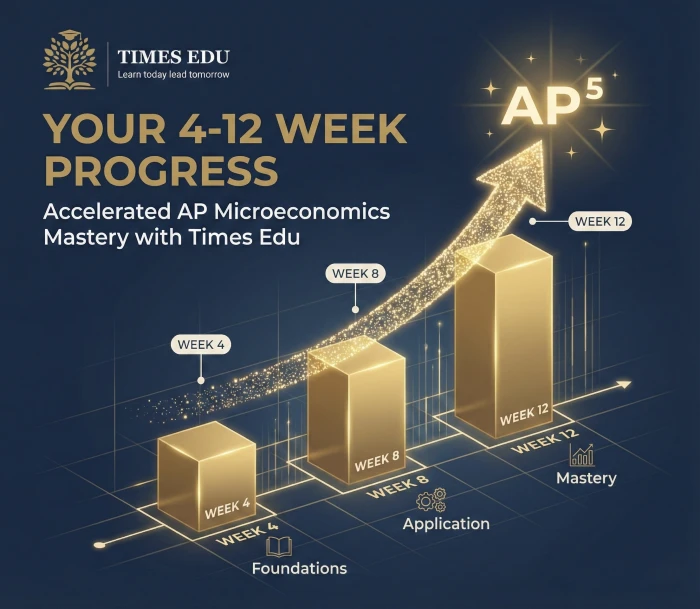
In 4–12 weeks, you will master:
Graph Accuracy
Draw perfect graphs for monopolies, perfect competition, and externalities from memory.
FRQ Scoring Structure
Learn the exact keywords that graders look for to award points immediately.
Better Marks-per-minute
Stop wasting time on fluff. Get to the point, draw the graph, move on.
Fewer "Small Mistakes"
Eliminate simple arithmetic or labeling errors that act as grade ceilings.
Get Your Free 30’ Diagnostic Session
Don't guess where you are losing marks. We'll identify your exact gaps in 30 minutes.
Component Breakdown
Detailed analysis of MCQ vs FRQ performance.
Top 3 Blockers
Identify the specific concepts holding you back.
Personal Plan
A custom 4–8–12 week roadmap to a 5.
The Official Exam Format
We train specifically for the Hybrid Digital delivery.
Section I: Multiple Choice
66.65% of Exam Score
- 60 Questions
- Knowledge & Computation
- No penalty for guessing
Section II: Free Response
33.35% of Exam Score
- 3 Questions (1 Long, 2 Short)
- Heavy graphing requirement
- 10 min reading period included
Calculator Rules & Logistics
Don't lose points on logistics. Use the allowed 4-function calculator or the built-in Desmos tool in Bluebook. We teach you how to use them efficiently for elasticity calculations.
Content Map: Where Points Come From
Prioritize your study time based on weighting.
| Unit | Topic | MCQ Weighting |
|---|---|---|
| Unit 1 | Basic Economic Concepts | 12–15% |
| Unit 2 | Supply and Demand | 20–25% |
| Unit 3 | Production, Cost, and the Perfect Competition Model | 22–25% |
| Unit 4 | Imperfect Competition | 15–22% |
| Unit 5 | Factor Markets | 10–13% |
| Unit 6 | Market Failure and the Role of Government | 8–13% |
Times Edu Strategy Playbook
MCQ Strategy
"Predict → Eliminate → Confirm"
Don't let distractors trick you. We teach a rigorous routine: cover the answers, solve the graph/math, predict the answer, and only THEN look at the options.
Long FRQ (Q1)
"Chain-of-reasoning that earns points"
Strict language requirements mean "it goes up" gets zero points. We teach the "Because X, Y shifts, leading to Z" template required for full credit.
Short FRQs (Q2 & Q3)
"Quick points, clean graphs"
Master the mini-graph routine. Learn short-answer frames to knock these out in under 15 minutes, saving time for the difficult questions.
Graph Mastery
"The Fastest Score Lever"
Welfare triangles, deadweight loss, profit maximization. Our one-page Graph Book and drills ensure you can draw any market structure in 30 seconds.
How Learning Works
A systematic approach to score improvement.
Assess
Diagnostic test to find gaps.
Learn
Targeted lessons on weak units.
Drill
FRQ & Graph repetition.
Report
Weekly progress updates.
Frequently Asked Questions
How often do classes meet?
Is the material updated for the current exam year?
Do you provide practice exams?
Ready to secure your 5?
Choose your starting point below.