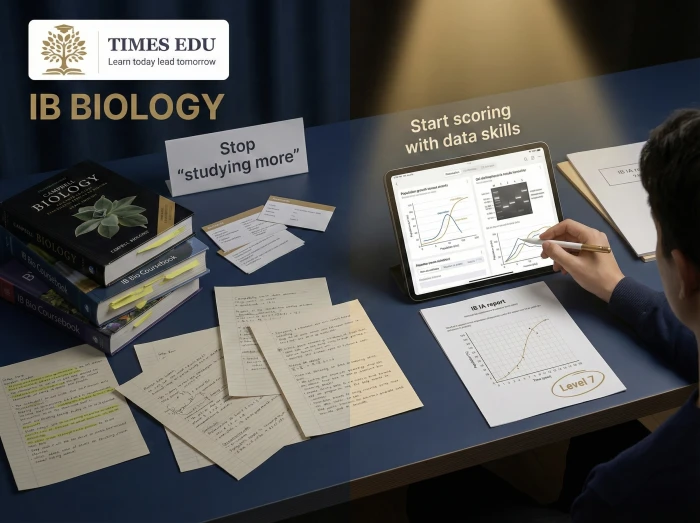
IB Biology — Stop “studying more”. Start scoring with data skills.
Times Edu trains IB Biology the way it’s assessed: concept → evidence → data interpretation → precise scientific writing. Gain marks in Paper 1B/2A data questions and Paper 2B extended responses (not just “content recall”).
2 External Exams
May & Nov Sessions
Paper Weightings
P1 (36%), P2 (44%), IA (20%)
Get a personal score roadmap included with diagnostic.
Why students lose marks in IB Biology
Common pain points we address directly in our curriculum.
MCQ Traps
Students fall for distractors in Paper 1A because they rely on intuition rather than elimination protocols.
Data Interpretation
Losing marks in Paper 1B/2A by describing the graph instead of interpreting the trend.
Vague Writing
Extended responses in Paper 2B fail because keywords are missing or logic is unstructured.
IA Uncertainty
Choosing a complex IA topic but failing on simple personal engagement and evaluation criteria.
Outcomes: What improves in 4–12 weeks
- checkHigher Paper 1A Accuracy: Systematic elimination of distractors.
- checkStronger Data Handling: Ability to interpret error bars and statistical significance.
- checkMark-Secure Writing: Structure Paper 2B answers to hit every mark scheme point.
- checkIA Clarity: A clear roadmap for RQ, methodology, and evaluation.
- checkBetter Marks-Per-Minute: Exam timing strategy that prevents rushing.
Free 30’ Diagnostic
Identify your weak spots before the exams. Get a full breakdown by component and a personalised roadmap to a Level 7.
Program Structure & Assessment
Understanding the difference between Standard and Higher Level.
Standard Level (SL)
Core foundational biology.
What Changes?
HL requires more depth, more topics, and significantly longer exams.
Higher Level (HL)
Extension material + additional topics.
Paper 1
36% Weighting
- 1A: Multiple-choice questions. Tests knowledge & recall.
- 1B: Data-based questions. Tests analysis of unseen data.
Paper 2
44% Weighting
- 2A: Data-based & short answer questions.
- 2B: Extended-response questions. Requires deep understanding and synthesis.
Internal Assessment (IA)
20% Weighting
- Scientific Investigation (10 hrs).
- Tests design, evaluation, data analysis, and communication skills.
Biology Roadmap: Themes & Topics
The 4 broad organizing themes of the new curriculum.
Unity & Diversity
Common ancestry, classification, cells.
Form & Function
Adaptations, physiology, movement.
Interaction & Interdependence
Ecosystems, neural signaling, hormones.
Continuity & Change
Evolution, genetics, inheritance.
Times Edu Strategy Playbook
How our students gain marks fast in every paper.
A) Paper 1A (MCQ) — Fastest Accuracy Gains
We teach distraction elimination protocols. Don't guess; prove 3 options wrong.
B) Paper 1B / 2A (Data-based) — The Real Differentiator
Master the art of trend analysis, correlation vs causation, and error bar interpretation.
C) Paper 2B (Extended Response) — Where 6→7 Happens
Learn to draft structured, scientific arguments that directly address mark scheme keywords.
D) IA Scientific Investigation — Score with Design
We help you refine your RQ and methodology to ensure high marks in evaluation and communication.
How learning works at Times Edu
Concept Delivery
High-yield content focus aligned with the new curriculum.
Guided Practice
Solving questions with the tutor to model thinking processes.
Independent Drill
Timed execution of exam-style questions.
Feedback Loop
Detailed correction and weekly progress updates to parents.
Frequently Asked Questions
Do you cover both SL and HL content?
expand_more
Yes, our classes are structured to cover the core content relevant to both, with breakout sessions or dedicated hours for HL-specific topics.
How do you help with the Internal Assessment?
expand_more
We provide guidance on selecting a viable research question, designing a robust methodology, and ensuring the evaluation section meets high-scoring criteria.
Can I book a single session for specific topics?
expand_more
While we recommend our structured roadmap for consistent improvement, we do offer targeted bootcamps for Data-based questions and Extended Response writing.